
Strategic intelligence is the practice of systematically gathering, analysing, and interpreting information about change to inform better decisions. It transforms raw observations, what strategists call signals, into structured insights that help organisations anticipate shifts, identify opportunities, and prepare for disruption.
At its core, strategic intelligence bridges the gap between what's happening in the world and what it means for your strategy. It answers the fundamental question: What changes matter, and how should we respond?
For strategy leaders and consultants, this discipline provides the evidence base for confident recommendations. Rather than relying on intuition or reacting to events after they unfold, strategic intelligence creates a structured approach to understanding change before it becomes obvious.
.png)
The field encompasses several interconnected practices: scanning for early indicators, clustering related observations into patterns, evaluating the trajectory and impact of emerging trends, and translating those insights into strategic options. Done well, it creates a continuous flow of intelligence that keeps strategy grounded in reality.
I built Portage around this principle: strategy work should start with a clear understanding of the forces shaping your operating environment. The Trend Database and Trend Reports exist precisely to make this practice accessible and rigorous, rather than ad hoc and overwhelming.
Traditional strategic planning assumes a degree of environmental stability that no longer exists. Annual planning cycles, static competitor analysis, and five-year forecasts made sense when change was gradual and predictable. That world is gone.
Today's strategy leaders face compounding uncertainty. Technological shifts, regulatory changes, demographic transitions, and geopolitical tensions interact in ways that defy simple extrapolation. The organisations that thrive are those that develop the capacity to sense change early and adapt continuously.
The cost of ignorance is rising. Consider how quickly generative AI moved from research curiosity to business imperative. Organisations with robust signal-scanning practices saw the implications early. Those without scrambled to respond after competitors had already moved.
Strategic intelligence addresses three critical challenges:
Information overload. Strategy teams drown in data, reports, and opinions. Without a structured approach, important signals get lost in noise. The discipline of strategic intelligence provides filters and frameworks that separate what matters from what's merely interesting.
Confirmation bias. Leaders naturally gravitate toward information that confirms existing beliefs. A rigorous intelligence practice surfaces uncomfortable signals that challenge assumptions and reveal blind spots.
Action paralysis. Understanding change means nothing without the ability to respond. Strategic intelligence connects observation to implication, creating the bridge from "we noticed this" to "here's what it means for our choices."
For consultants, this capability differentiates advisory work. Clients expect more than frameworks - they want partners who bring genuine insight about the forces shaping their industry. Strategic intelligence provides that foundation.
Understanding how signals become actionable intelligence requires clarity on several foundational concepts. Each builds on the others to create a coherent approach to sensing and interpreting change.
Signals are individual observations that hint at emerging change. A new regulation in one market, an unexpected product launch, a shift in consumer behaviour, a research breakthrough - each represents a potential indicator of something larger. Signals are specific, observable, and often ambiguous in isolation.
The challenge with signals is volume. Thousands of potentially relevant observations emerge daily. Effective strategic intelligence requires systems for capturing signals without drowning in them.
→ Read more: Signals vs Trends: A Modern Foresight Framework
When multiple signals point in similar directions, patterns emerge. Clustering groups related signals into coherent themes, revealing connections that individual observations obscure. A dozen signals about remote work adoption, digital collaboration tools, and office vacancy rates cluster into a pattern about workplace transformation.
Pattern recognition is where intelligence work shifts from collection to analysis. It requires both systematic methods and strategic judgement.
→ Read more: Trend Clustering Techniques (With Examples)
Trends represent sustained, directional shifts with observable evidence and forward momentum. Unlike signals (single observations) or patterns (grouped observations), trends have velocity and trajectory. They describe where things are heading, not just what's happening now.
A mature trend has multiple supporting signals, clear drivers, and identifiable implications for strategy. Understanding trend momentum and maturity helps strategists gauge timing and urgency.
→ Read more: How to Develop Trends from Signals: A Step-by-Step Process
Trends don't emerge randomly. They result from underlying forces - technological capabilities, demographic shifts, regulatory pressures, economic dynamics- that create the conditions for change. Understanding these drivers helps strategists distinguish durable trends from temporary fluctuations.
Forces operate at different levels: macro-level shifts (like ageing populations) create conditions; meso-level drivers (like healthcare cost pressures) shape specific sectors; micro-level indicators (like telehealth adoption rates) provide measurable evidence.
→ Read more: Indicators, Drivers & Forces: Building Blocks of Trends
The ultimate purpose of strategic intelligence is informing decisions. Impact analysis evaluates how trends affect your organisation's opportunities, risks, and strategic options. This step transforms general intelligence into specific strategic input.
Effective impact assessment considers both direct effects (how a trend affects your market) and indirect effects (how it changes competitor behaviour, customer expectations, or resource availability).
→ Read more: How to Evaluate Trend Impact (Opportunities, Risks, Uncertainties)
Visual frameworks like trend radars and structured taxonomies help teams navigate complex intelligence. They provide shared mental models for discussing change and prioritising attention. A well-designed taxonomy classifies trends by domain, maturity, and relevance—making large trend sets manageable.
→ Read more: How to Build a Trend Radar: A Complete Guide
I designed Portage around a specific methodology for transforming raw signals into strategic intelligence. This six-step process reflects how expert foresight practitioners work, made accessible through purpose-built tools.
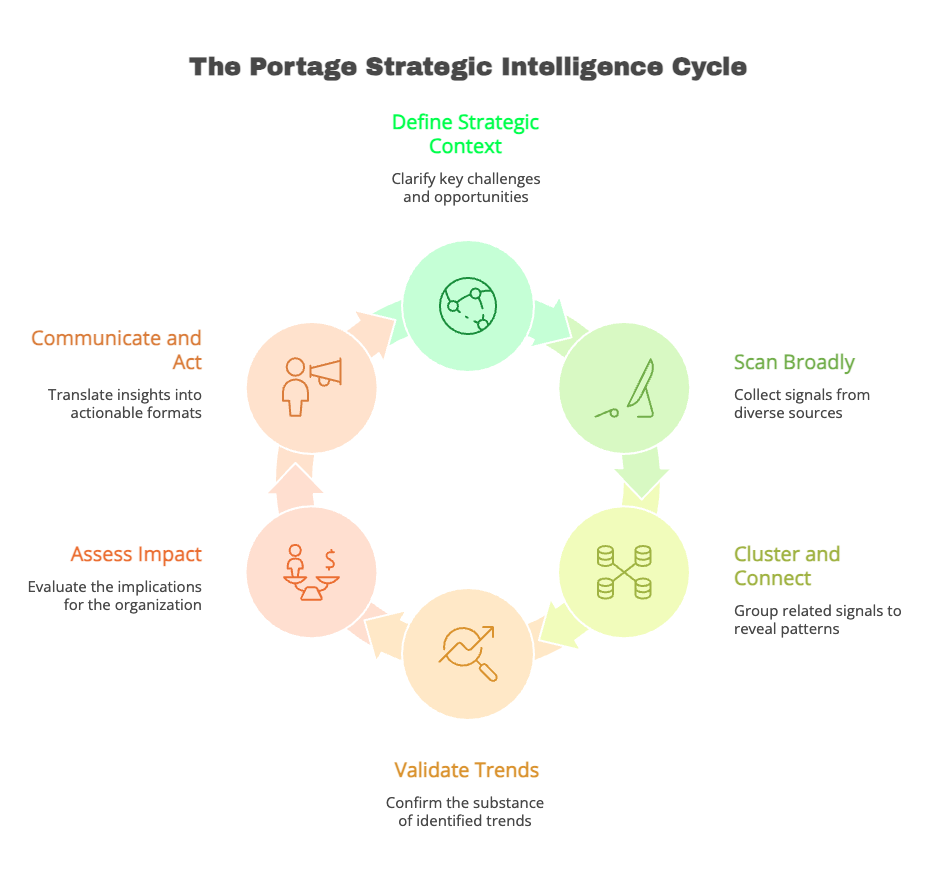
Effective intelligence gathering starts with clarity about what matters. Before scanning for signals, articulate the key challenges, opportunities, or questions your strategy needs to address. This focus prevents the common trap of collecting interesting but irrelevant information.
In Portage, Trend Reports are configurable to meet the needs of your stakeholders—targeting research to your specific strategic concerns rather than generic industry coverage.
Signal collection requires disciplined breadth. The most valuable signals often come from adjacent industries, emerging markets, or unexpected domains. The practice of horizon scanning deliberately looks beyond familiar sources.
Portage's Trend Database provides curated foresight insights and weak signals, structured across domains and subthemes. This gives teams a foundation of pre-analysed intelligence to build upon.
Raw signals gain meaning through relationship. Clustering techniques group related observations, revealing patterns that individual signals obscure. This step often produces the "aha" moments—sudden clarity about a shift that was hiding in plain sight.
The AI summarisation and cross-linking in Portage's Trend Database supports this process, helping strategists see connections across their intelligence base.
Not every cluster represents a genuine trend. Validation tests whether patterns have substance: Are there multiple independent signals? What forces drive this shift? What evidence would confirm or refute the trajectory?
Developing trends means building out their context—understanding momentum, maturity, and the conditions that could accelerate or reverse them.
Here, strategic intelligence meets strategic choice. Impact assessment connects validated trends to your organisation's context: What opportunities emerge? What risks intensify? What assumptions should you question?
Portage's Strategy Boards integrate trends into strategy development, allowing teams to map how specific trends affect strategic options and objectives.
Intelligence that stays in analysts' heads creates no value. The final step translates insights into formats that enable decision-making—reports, briefings, scenarios, and strategic recommendations.
Trend Reports in Portage automatically generate insights and visual summaries, creating consistent outputs that stakeholders can engage with and act upon.
Signals vs Trends: A Modern Foresight Framework Clarify the relationship between signals and trends, with practical guidance on distinguishing early indicators from validated shifts.
How to Develop Trends from Signals: A Step-by-Step Process Portage's complete methodology for transforming observations into structured trend intelligence, with examples and templates.
Indicators, Drivers & Forces: Building Blocks of Trends Understanding the architecture of change—how macro forces create trends and how indicators help you track them.
How to Evaluate Trend Impact (Opportunities, Risks, Uncertainties) A practical framework for connecting trend intelligence to strategic decisions, including assessment criteria and prioritisation methods.
How to Build a Trend Radar: A Complete Guide Step-by-step instructions for creating visual trend maps that communicate complexity clearly.
Trend Clustering Techniques (With Examples) Methods for grouping and organising signals effectively, with worked examples from different industries.
Trend Report Template (with Portage UI examples) A ready-to-use template and examples showing how to structure trend reports for different stakeholder audiences.
Understanding Trend Momentum and Maturity How to gauge where a trend sits in its lifecycle and what that means for strategic timing.
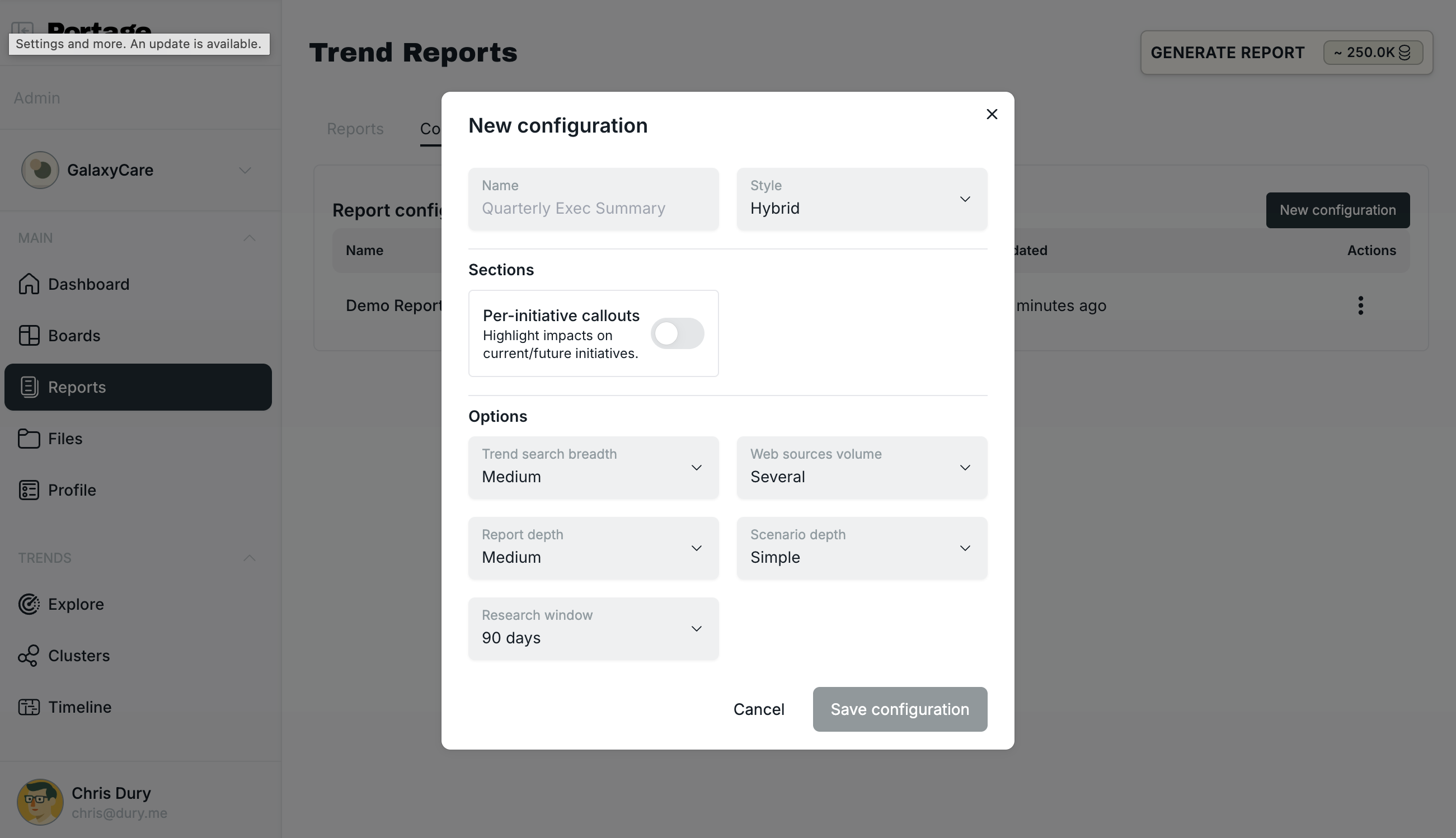
The Trend Reports feature brings this methodology to life in a structured workflow. Here's how it works:
[Screenshot placeholder: Trend Report configuration interface]
Configure your intelligence scope. Set up a Trend Report targeting specific strategic challenges or opportunities. Define the domains, themes, and questions that matter to your context.
AI-powered research gathering. The AI agent gathers targeted research, bringing together insights from curated trends, your uploaded files, and relevant intelligence from across the web.
Structured outputs. Reports synthesise findings into clear summaries with key trends, supporting evidence, and strategic implications. Schedule email delivery or run reports on-demand as your needs evolve.
The Trend Database provides the foundation—structured foresight insights organised by domain and subtheme, with AI summarisation that makes large trend sets navigable. Teams can explore weak signals, understand cross-linkages, and build evidence-based strategic inputs.
For consultants managing multiple clients, Multi Workspaces keeps intelligence organised with separate spaces, distinct permissions, and secure data isolation.
The best way to experience strategic intelligence in practice is to generate your first Trend Report. Configure a report around a strategic question that matters to your work right now—an emerging technology, a shifting customer behaviour, a regulatory uncertainty.
→ Generate your first Trend Report
Within minutes, you'll have a structured intelligence output that demonstrates how signals become actionable insights.
Continue your exploration: Learn how strategic intelligence connects to [Foresight & Scenario Planning] for testing strategies against alternative futures, or discover how [Adaptive Strategy & Learning Loops] creates the feedback systems that keep strategy responsive to change.