Strategic foresight is the disciplined practice of exploring, anticipating, and preparing for multiple possible futures. It moves beyond prediction, which assumes we can know what's coming, to preparation, which acknowledges that the future is inherently uncertain.
Scenario planning is a core method within foresight. It involves constructing plausible, coherent narratives about how the future might unfold, then using those narratives to stress-test current strategies and surface blind spots.
Together, foresight and scenario planning form a systematic approach to strategic decision-making under uncertainty.
.png)
Rather than betting on a single forecast, strategy leaders use these methods to:
Portage treats foresight not as a separate exercise from strategy, but as an integral part of how good strategy gets made. I built the platform to connect the dots between scanning for change, generating scenarios, and testing strategic choices from a single workspace. This matters because foresight that doesn't connect to decisions is just speculation. And strategy that ignores the future is just a guess dressed up as a plan.
For strategy leaders and consultants, this domain encompasses trend analysis, horizon scanning, weak signal detection, scenario construction, and impact assessment.
It's the forward-looking dimension of strategic work.
The business environment has changed. The assumption that tomorrow will resemble today and that you can extrapolate from historical data and call it planning no longer holds.
Consider what strategy leaders face now:
Traditional strategic planning struggles here because annual plans assume stability. SWOT analyses capture a snapshot, not a moving picture. Forecasting models break down when the underlying patterns shift.
This is where foresight becomes essential, not as a luxury for futurists, but as a core competency for any leader making consequential decisions.
When I work with strategy teams, I see the same pattern: they're drowning in data but starved for insight about what it means for their future. They have dashboards tracking lagging indicators, but no systematic way to spot emerging forces early enough to respond.
Foresight addresses this gap. It helps you:
The stakes are concrete. Organisations that build foresight capability don't just avoid surprises they perform better with 33% greater profit and 200% greater growth than their competitors.
This domain spans several interconnected concepts. Each plays a specific role in helping you move from uncertainty to informed action.
Strategic foresight is a structured approach to thinking about the future as a way to improve decisions today. It combines systematic research, creative exploration, and strategic analysis. Unlike forecasting, which attempts to predict what will happen, foresight explores what could happen and what that means for your choices now.
→ Read: What Is Strategic Foresight? A Practical Guide for Leaders
Scenarios are plausible, internally consistent narratives about how the future might unfold. They're not predictions or preferences. They're thinking tools. Good scenarios challenge assumptions, reveal hidden dependencies, and help teams rehearse responses to different conditions. They typically explore 3-5 distinct futures that span the range of relevant uncertainty.
→ Read: Scenario Planning: A Complete Guide (With Examples)
Scenario planning is most valuable when facing strategic decisions with long time horizons and significant uncertainty. It's particularly useful for investment decisions, market entry, major capability builds, or any choice where being wrong carries serious consequences. Knowing when to deploy scenarios, and when simpler methods suffice, is itself a strategic skill.
→ Read: How to Create Effective Scenarios (Step-by-Step)
These are systematic approaches to monitoring the external environment for signals of change. Horizon scanning typically focuses on emerging issues and longer time frames, while environmental scanning often addresses nearer-term competitive and market dynamics. Both feed the foresight process with raw material.
→ Read: Horizon Scanning vs Environmental Scanning: Key Differences
Weak signals are early, ambiguous signs of potential change. They're easy to dismiss or overlook, often appearing first at the margins, in unexpected places, or in forms that don't fit existing mental models. Detecting and interpreting weak signals is one of the highest-value foresight skills.
The foresight field has developed numerous methods: Delphi surveys for expert consensus, Causal Layered Analysis for understanding deep drivers, backcasting for normative exploration, and more. Each has specific applications and limitations.
→ Read: Tools & Methods in Foresight (Delphi, Causal Layered Analysis, etc.)
I designed Portage around a specific point of view: foresight should connect directly to strategic decisions, not sit in a separate silo.
Too often, I've seen organisations invest in trend reports that gather dust, run scenario workshops that produce interesting discussions but no follow-through, or build foresight functions that operate at arm's length from the strategy team. The insights never connect to the choices that matter.
Portage integrates foresight into Adaptive Strategy Design through five connected stages:
.png)
Start by gathering strategic intelligence relevant to your context. This isn't about collecting everything—it's about filtering the noise to find signals that could meaningfully affect your strategic position.
The Trend Reports feature in Portage uses an AI agent to gather research targeted to your specific challenges or opportunities. You can schedule regular delivery or run reports on-demand, bringing together curated trends, your own uploaded files, and insights from across the web.
Next, map your current strategy by clearly defining the key choices, assumptions, and expected outcomes. This involves using your Strategic Profile to consolidate important elements, ensuring that your Strategy Boards guide this process step by step. By doing so, you create a comprehensive overview of your strategic landscape, which serves as a foundation for future planning and decision-making.
Transform your signals and trends into coherent future scenarios. The Scenario Generator in Portage helps you explore alternative futures without starting from a blank page.
Scenarios become strategically useful when you use them to interrogate your current plans. In Portage, stress tests link directly to your board objectives, helping you assess how your strategy would perform under different future conditions.
This is where foresight earns its value. A strategy that only works in your expected future is fragile. A strategy that remains sound across multiple scenarios is resilient.
→ Read: Scenario Archetypes: Growth, Collapse, Constraint, Transformation
→ Read: How to Turn Scenarios into Strategic Tests (Portage Stress Tests)
The insights from your stress tests inform your strategic choices. Strategy Boards in Portage let you capture not just what you decided, but why - the scenarios you considered, the trade-offs you weighed, the assumptions you're watching.
This documentation matters. When conditions change, you have a clear record of your reasoning to revisit and update.
Monitor the performance of strategies and compare actual outcomes against expectations. Use these insights to refine future sensing and framing cycles, ensuring continuous improvement and adaptation.
Most foresight approaches treat scanning, scenarios, and strategy as separate activities, often done by different teams at different times. Portage connects them in one workspace, so insights flow directly into decisions.
This isn't just about efficiency (though moving from trend scan to decision map in a single session matters). It's about quality. When foresight and strategy are integrated, you catch disconnects early. You notice when your strategy depends on assumptions your scenarios question. You build shared understanding across your team.
What Is Strategic Foresight? A Practical Guide for Leaders A foundational guide defining strategic foresight and explaining its role in modern strategy work. Start here if you're new to the field.
Scenario Planning: A Complete Guide (With Examples) A comprehensive walk-through of scenario planning methodology, including real-world examples and common pitfalls to avoid.
How to Create Effective Scenarios (Step-by-Step) A practical, step-by-step process for building scenarios that actually inform strategy—not just interesting stories.
Weak Signals: How to Spot Early Indicators of Change Techniques for identifying and interpreting weak signals before they become obvious trends. One of the highest-value foresight skills.
Horizon Scanning vs Environmental Scanning: Key Differences Clarifies the distinction between these related scanning approaches and when to use each.
How to Facilitate a Scenario Workshop A practical guide to running effective scenario workshops with your team or clients, including facilitation tips and common mistakes.
Scenario Planning Templates (Downloadable) Ready-to-use templates for scenario planning, including scenario matrix frameworks and documentation guides.
How to Turn Scenarios into Strategic Tests (Portage Stress Tests) The bridge from scenarios to action—how to use your scenarios to stress-test strategic choices in Portage.
Here's what the foresight workflow looks like inside Portage:
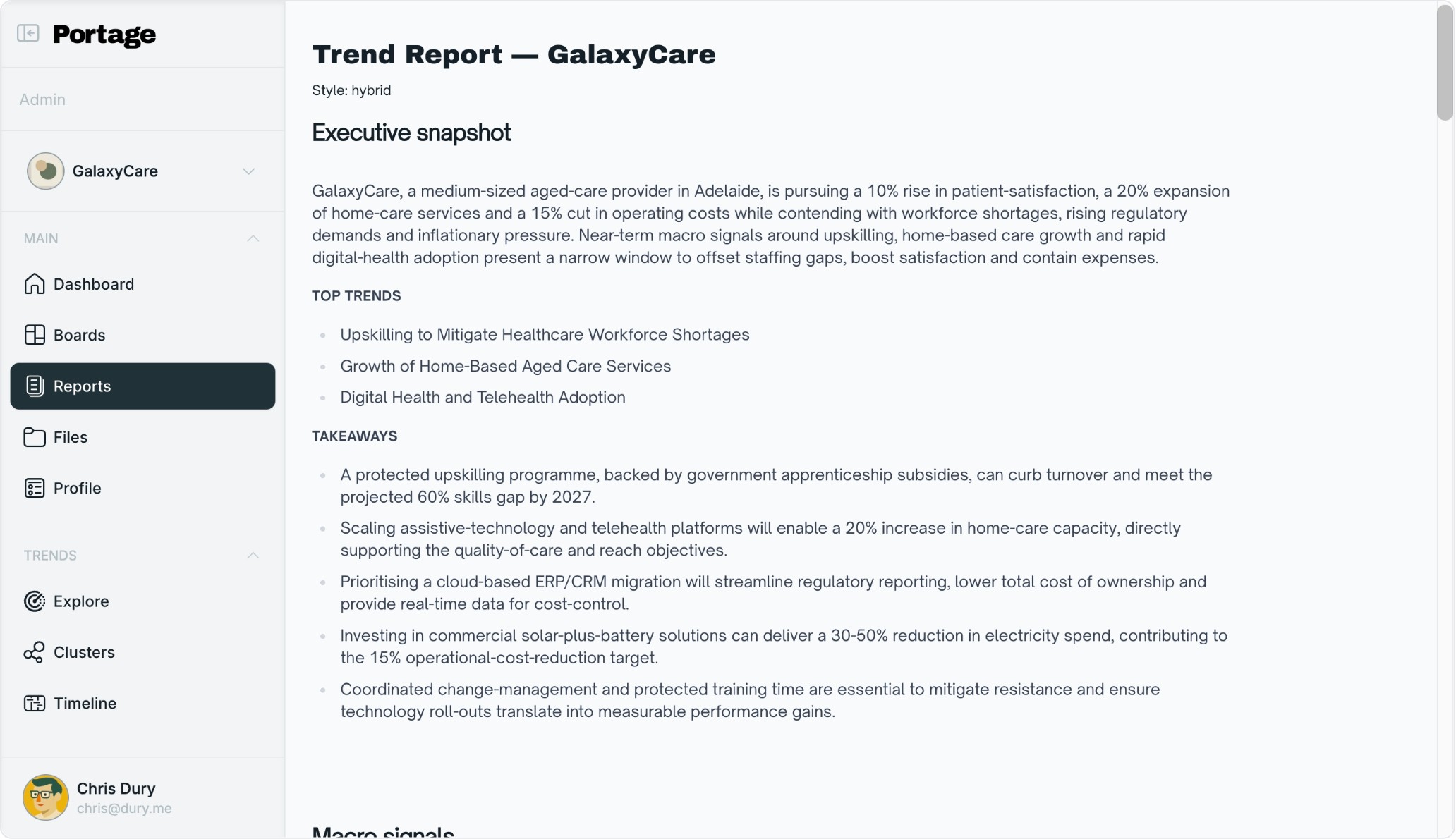
You begin with a Trend Report configured for your specific strategic questions. The AI agent gathers targeted research, synthesises findings, and delivers insights on your schedule.
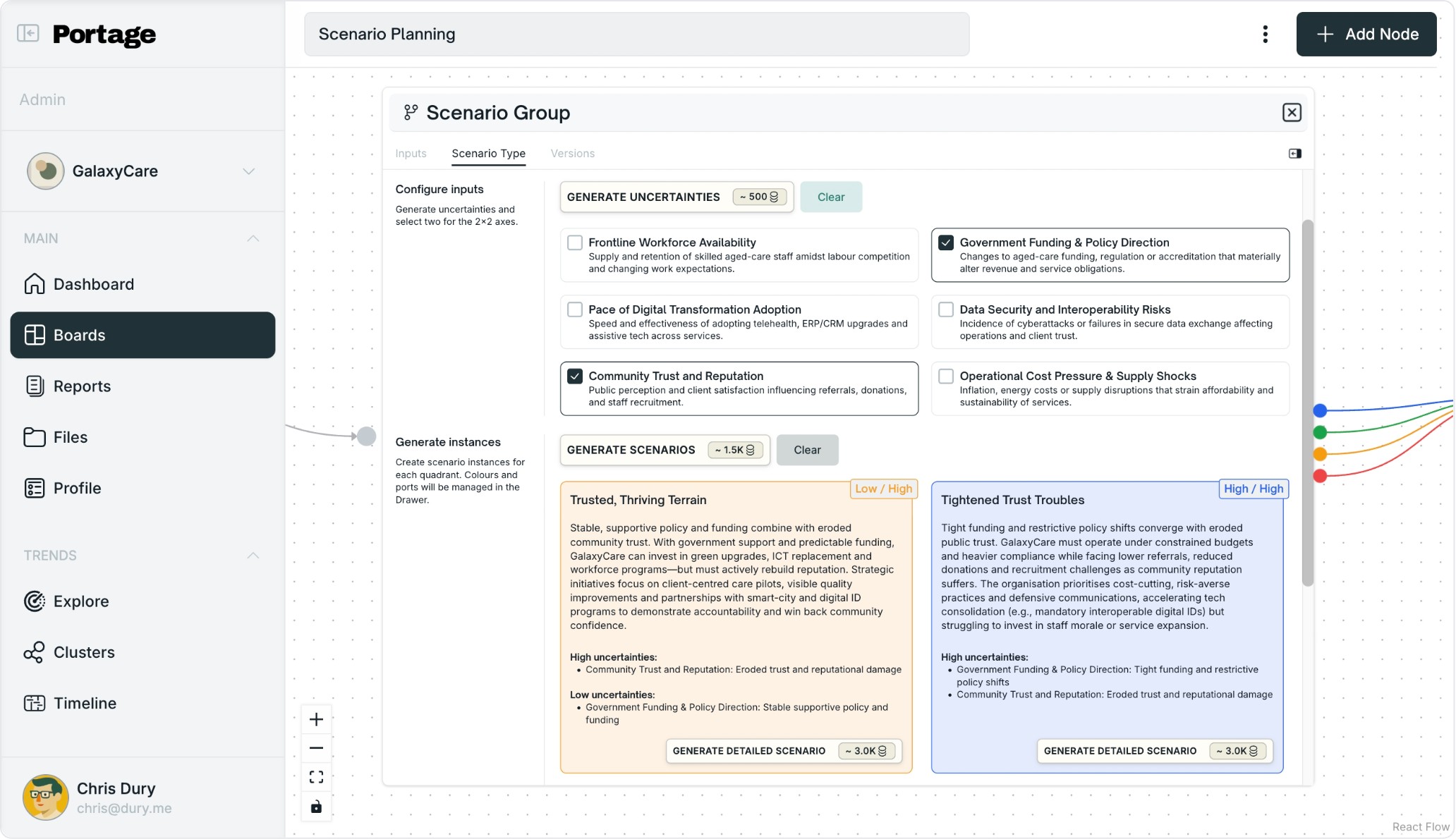
From there, you feed relevant trends into the Scenario Generator. Portage helps you build 3-5 distinct scenarios, using both AI-generated options and your own expert input. Each scenario becomes a lens for examining your strategy.
With scenarios in place, you run Stress Tests linked to your strategic objectives. This surfaces where your strategy is robust and where it's exposed—helping you identify options or hedges to consider.

Finally, everything connects to your Strategy Boards, where you document decisions and reasoning. Real-time collaboration means your team works together in one shared view, and comments capture the context behind choices.
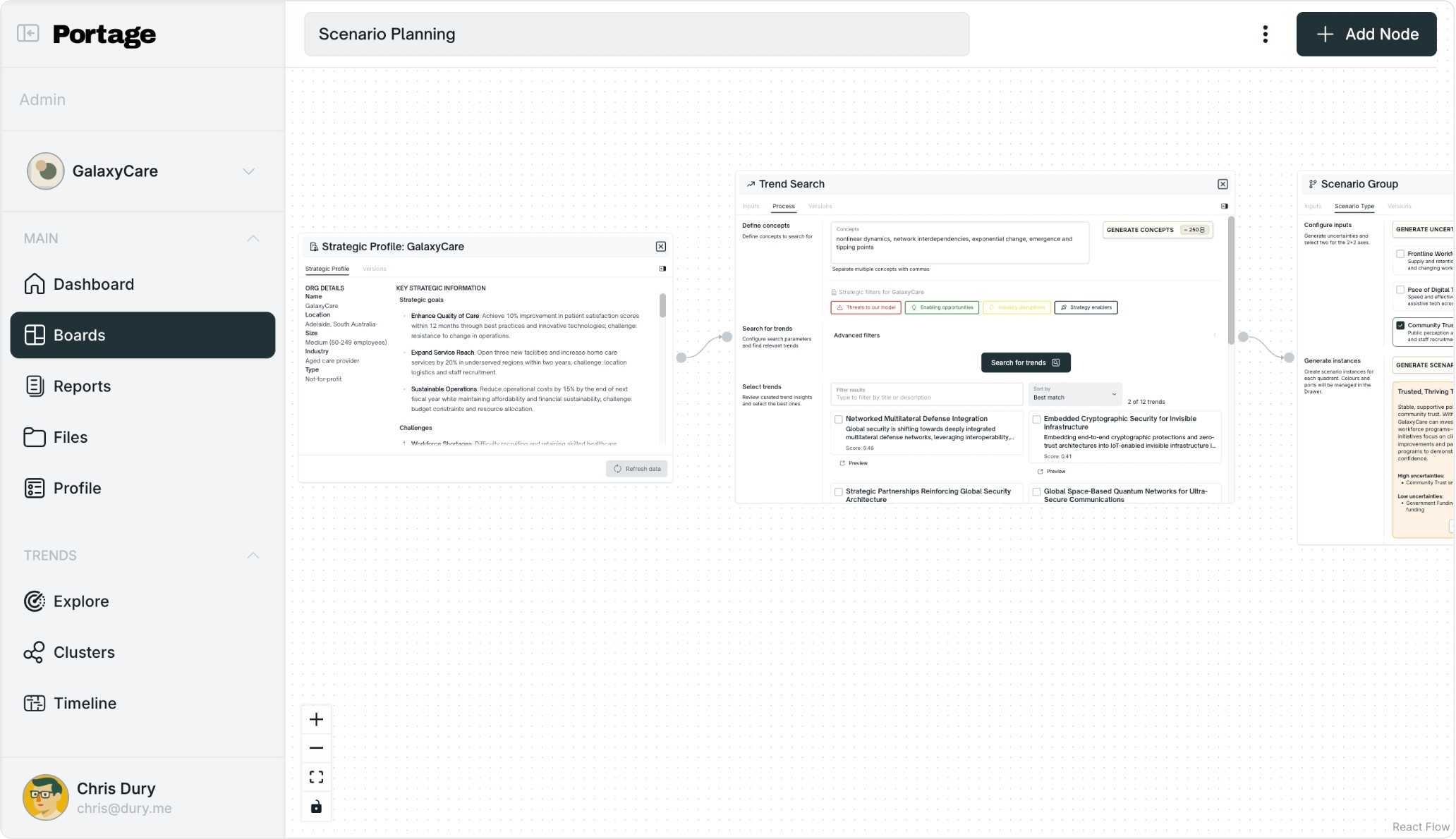
The workflow is designed for consultants managing multiple clients and corporate strategists working across business units. Multi Workspaces keep projects separate and secure while letting you apply consistent methods across engagements.
The best way to understand how Portage supports foresight work is to try it.
Generate your first Trend Report. Configure a report focused on a strategic challenge you're working on now. See what signals and patterns emerge when AI-driven research meets your domain expertise.
From there, use those insights to generate scenarios and run your first stress test. You'll move from scanning to strategic insight in a single session—the kind of progress that typically takes weeks of scattered work.
→ Generate your first scenario set