
Strategic trend domains are structured categories that organise the forces reshaping business, society, and geopolitics. They provide a framework for tracking change systematically — moving beyond ad-hoc environmental scanning toward disciplined strategic intelligence.
For strategy leaders and consultants, trend domains serve three critical functions:
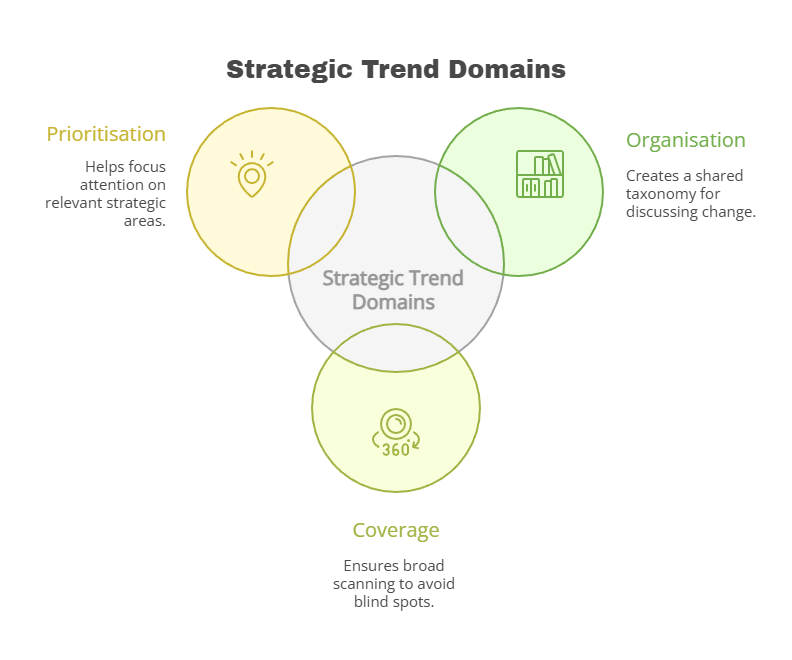
I've built Portage around nine interconnected trend domains. Each captures a distinct cluster of forces, from AI trajectories and geopolitical shifts to planetary boundaries and the future of work. Together, they form a comprehensive lens on the external environment.
This isn't about predicting the future. It's about developing peripheral vision to grow the ability to detect weak signals early, interpret their strategic implications, and adapt before competitors do.
The most effective strategists I've worked with share one trait: they invest consistently in understanding the forces beyond their immediate industry. Trend domains make that investment structured and actionable.
Traditional strategic planning assumed a relatively stable environment. You could analyse your industry, set a five-year plan, and execute with confidence. That world no longer exists.
Today's strategy leaders face a fundamentally different challenge. The forces reshaping business operate across multiple domains simultaneously. An AI breakthrough triggers regulatory responses, which shift competitive dynamics, which alter workforce requirements, and all of this happens within weeks or months, not years.
The cost of narrow scanning compounds over time. Organisations that track only their immediate industry develop "domain blindness", an inability to see threats and opportunities originating outside their traditional competitive frame.
Three shifts make comprehensive trend tracking essential:
Acceleration: The pace of change in any single domain has increased. AI capabilities that once took years to develop now emerge quarterly. Regulatory frameworks struggle to keep pace with technological change.
Interconnection: Domains don't move independently. Demographic shifts influence labour markets, which affect automation adoption, which shapes AI development priorities. Strategy that ignores these connections misses the compounding effects.
Volatility: Black swan events increasingly originate from domain intersections. The organisations that navigate volatility best are those with broader situational awareness.
For strategy leaders and consultants, this means one thing: you need a systematic approach to tracking trends across domains, not just within your industry. Occasional environmental scans aren't sufficient. You need continuous, structured intelligence.
I've organised Portage's foresight capability around nine strategic trend domains. Each captures a distinct set of forces, but the real insight often emerges at the intersections.
Artificial intelligence is reshaping every industry, but the trajectory isn't linear. Compute availability, model architectures, and deployment costs create constraints that matter for strategic planning. Understanding where AI is heading — and what's slowing it down — separates informed strategy from hype-driven decisions.
→ Read: AI Trajectories & Compute Constraints: Strategic Implications
The global order is fragmenting. Supply chains, technology access, and market entry now depend on understanding shifting alliances, trade policies, and security concerns. Strategists who treat geopolitics as "macro noise" consistently underestimate its operational impact.
→ Read: Geopolitical Power & Security Realignments: What Strategists Need to Know
Interest rates, inflation, capital availability — these forces determine what strategies are financeable and which markets are accessible. Understanding macroeconomic trends helps you time investments and anticipate competitive pressure from well-capitalised rivals.
→ Read: Macroeconomics & Capital Flows: Strategic Trend Analysis
Consumer preferences, workforce expectations, and social license to operate all stem from shifting values and demographic realities. These trends move slowly but powerfully — ignoring them creates strategic risk that compounds over time.
→ Read: Societal Values & Demographics: Understanding Shifting Landscapes
Climate change, biodiversity loss, and resource scarcity are no longer future concerns. They're present constraints that affect supply chains, regulatory environments, and consumer behaviour. Strategies that ignore planetary boundaries face increasing operational and reputational risk.
→ Read: Planetary Boundaries & Resource Constraints: Strategy Implications
The shift from fossil fuels to renewable energy is restructuring entire industries. For strategists, this creates both risk (stranded assets, regulatory exposure) and opportunity (new markets, cost advantages). Understanding the pace and pattern of transition matters.
→ Read: Energy & Infrastructure Transitions: Strategic Opportunities
Regulatory frameworks are struggling to keep pace with technological and social change. This creates uncertainty — but also strategic opportunity for organisations that anticipate regulatory direction and shape the conversation proactively.
→ Read: Governance, Regulation & Ethics: Navigating the Policy Landscape
Business models, platform dynamics, and competitive structures are evolving. Some industries are consolidating; others are fragmenting. Understanding the forces reshaping industry architecture helps you position for the competitive environment that's emerging, not the one that exists today.
→ Read: Industry Architecture & Competitive Logic: Emerging Patterns
How people work, what skills matter, and what organisational cultures attract talent — all are shifting rapidly. These trends affect your ability to execute strategy, not just your strategic choices. They deserve the same rigour you apply to market analysis.
→ Read: Work, Skills & Cultural Futures: Preparing for Change
I built Portage around a specific philosophy: trend tracking should be continuous, structured, and actionable — not an annual exercise buried in a PowerPoint deck.
Here's how I think about effective strategic intelligence:
You don't need to track every signal. You need to track the right signals — those with genuine strategic relevance, not just newsworthiness. Portage's Trend Database focuses on curated foresight insights and weak signals, not a firehose of information.
Raw information isn't intelligence. Structure is what transforms data into insight. The nine domains provide consistent categorisation. AI summarisation and cross-linking help you see connections. Structured subthemes let you zoom in on what matters for your specific context.
A trend is only strategically relevant when you've assessed its implications for your organisation. That's why Portage connects trend intelligence directly to Strategy Boards — so you can move from "interesting signal" to "strategic implication" without switching tools.
The organisations that respond best to change aren't those with the best annual planning processes. They're the ones with continuous sensing capabilities. Trend Reports that you can schedule and generate on demand support this ongoing intelligence workflow.
The most important strategic signals often emerge at domain intersections. An AI trend collides with a regulatory trend. A demographic shift intersects with an energy transition. Portage's cross-linking capability helps surface these connections systematically.
The goal isn't to know more. It's to decide better. Every element of Portage's trend capability is designed to feed into strategic decisions — through scenario testing, impact analysis, and board integration.
[AI Trajectories & Compute Constraints: Strategic Implications] A deep analysis of where AI is heading and what constraints will shape its adoption. Essential for any strategist evaluating AI-related opportunities or threats.
[Geopolitical Power & Security Realignments: What Strategists Need to Know] How shifting global alliances and security concerns affect supply chains, market access, and competitive dynamics. Critical for organisations with international exposure.
[Planetary Boundaries & Resource Constraints: Strategy Implications] Why environmental constraints are now strategic constraints — and how to build them into your planning processes.
[Industry Architecture & Competitive Logic: Emerging Patterns] Understanding how business models and competitive structures are evolving across sectors. Useful for positioning and investment decisions.
[Governance, Regulation & Ethics: Navigating the Policy Landscape] How regulatory uncertainty creates both risk and opportunity. A guide to anticipating and influencing the policy environment.
[Monthly 'Top Trends' Report Template] A structured format for creating monthly trend summaries that stakeholders actually read. Includes guidance on signal selection and strategic framing.
[Portage Trend Index (Quarterly)] A quarterly synthesis of trend movements across all nine domains. Useful for calibrating your own assessments against broader patterns.
[Signal Deep Dives: 'Why This Matters for Strategy'] A template for analysing individual signals in depth. Helps you move from "interesting observation" to "actionable intelligence."
Here's how trend intelligence works in Portage:
Step 1: Select Your Focus Domains
Start by identifying which of the nine trend domains matter most for your strategic context. A healthcare organisation might prioritise AI trajectories, governance, and demographics. A manufacturing company might focus on energy transitions, geopolitical realignment, and supply chain dynamics.
Step 2: Access Curated Intelligence
The Trend Database provides curated foresight insights across your selected domains. AI summarisation helps you quickly grasp the key points. Structured subthemes let you drill into specific areas.
[Screenshot placeholder: Trend Database interface showing domain navigation and AI summaries]
Step 3: Generate Targeted Reports
Trend Reports let you gather research targeted to your key challenges or strategic opportunities. The AI agent brings together curated trends, your uploaded files, and insights from around the web. You can run reports on demand or schedule regular delivery.
[Screenshot placeholder: Trend Report configuration showing domain selection and delivery options]
Step 4: Connect to Strategic Decisions
The real power comes from integration. Import relevant trends directly into Strategy Boards, where you can assess their implications, test them against scenarios, and document your reasoning. This closes the loop from intelligence to decision.
Ready to build systematic trend tracking into your strategy process?
Try generating a Trend Report — Select one of the nine domains, configure the report to focus on your key challenges, and see how AI-assisted research surfaces relevant signals. [Generate your first Trend Report →]
The report will bring together curated intelligence from Portage's Trend Database, your own uploaded materials, and insights from around the web — all structured for strategic relevance.
Want regular strategic intelligence? Subscribe to the Portage newsletter for monthly trend summaries and quarterly synthesis reports. We track what's moving across all nine domains so you can focus on what matters for your specific context.
[Subscribe to strategic intelligence updates →]